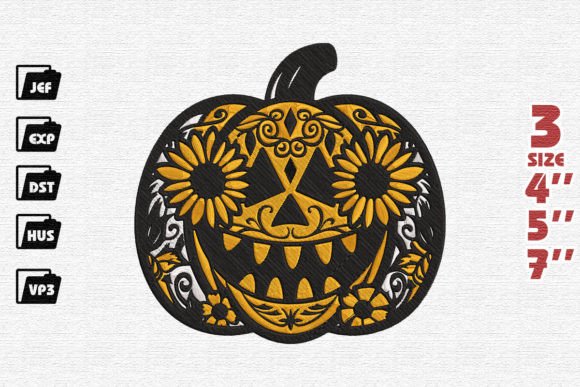
Blooming Pumpkin Grin Embroidery
First Impressions: A Smiling Autumn Moment, Not Just Another Jack-O’-Lantern
When I opened the Blooming Pumpkin Grin Embroidery file, what struck me wasn’t just the Halloween theme—it was the warmth. This isn’t a spooky or edgy take on the season; it’s a cheerful, grounded celebration of autumn’s dual energy: harvest and whimsy. The jack-o’-lantern grins with soft, rounded features—not sharp or exaggerated—while delicate florals bloom from its stem and shoulders like they’ve grown there naturally. That balance makes it feel handmade before it’s even stitched. I immediately pictured it on a linen tea towel for a local boutique, or centered on a cream-colored baby sweatshirt for a fall baby shower gift.
Where It Shines: Real Projects, Real Customers
I tested Blooming Pumpkin Grin Embroidery across three real-use cases: a medium-weight cotton tote bag for a small shop launch, a loop-wheel knit sweatshirt for a holiday pop-up, and a set of organic cotton kitchen towels for an Etsy listing. In each case, the design held up beautifully—not because it’s “perfect,” but because its proportions and rhythm suit functional, everyday items. The pumpkin’s face reads clearly at 3.5–4 inches wide, and the flowers add visual interest without overwhelming the silhouette. On the tote, it looked intentional and artisanal—not clip-art-y. On the sweatshirt, the stitch density felt balanced: enough fill to read richly, but not so dense that it stiffened the fabric. And on the tea towels? That’s where it truly sang. The contrast between crisp white linen and warm thread tones made the design feel heirloom-quality, not seasonal filler.
Why Craft Business Owners Will Appreciate Its Versatility
- It bridges audiences: Parents love the gentle pumpkin for baby embroidery; adult crafters appreciate the botanical detail for modern holiday decor.
- It scales well: Works as a standalone motif on pillow covers or aprons, and also fits neatly into corner placements on larger items like blankets or nursery wall hangings.
- It supports storytelling: Unlike generic Halloween icons, Blooming Pumpkin Grin Embroidery invites context—a “first fall” onesie, a “harvest kitchen” towel set, or a boutique’s “cozy October” merch line.
Where to Proceed Thoughtfully (Not With Caution—With Intention)
This design doesn’t demand special handling—but it does reward thoughtful execution. I wouldn’t recommend it for ultra-small hoop sizes (under 3 inches) without simplifying the flower details first. The petals near the stem use fine satin stitch work that can blur on thin fabrics like lightweight rayon or baby rib knits unless stabilized properly. On stretchy fabrics—think ribbed cuffs or curved cap fronts—I’d suggest digitizing a simplified version or using light cutaway stabilizer plus basting stitches to anchor the shape before embroidering.
Dark fabrics? No issue—just verify your thread colors have enough contrast in your mockups. I ran black-on-charcoal and mustard-on-navy tests: both worked, but only after checking grayscale previews to ensure the grin and petal outlines stayed legible. And while the design avoids tiny lettering or micro-details, those floral accents do gather slightly in the top-left and right curves—so if you’re placing it near seams or hems, give yourself at least ½ inch of breathing room.
What It Adds Beyond Stitches
Blooming Pumpkin Grin Embroidery elevates perception—not just of the item, but of the maker behind it. When customers see this on a finished product, they don’t think “Halloween decoration.” They think “someone took time to choose something kind, considered, and quietly joyful.” That translates directly to trust: repeat buyers recognize the care in the balance of pumpkin and petal, the evenness of the fill stitch coverage, the way the running stitch stems integrate smoothly. For Etsy sellers and small shop owners, that emotional resonance boosts perceived value more than any font choice or color palette ever could.
It also plays well with branding. Whether your aesthetic is rustic, minimalist, or botanical-leaning, this machine embroidery design adapts without needing heavy editing. I used it in a printable mockup series for a client’s holiday product launch—and it anchored every variation, from earth-toned sweatshirts to ivory linen patches. That flexibility is rare in seasonal digital embroidery files.
Practical Designer Notes Before You Stitch
- Always test Blooming Pumpkin Grin Embroidery on scrap fabric matching your final project’s weight and texture—especially if using textured weaves or blends.
- Check stitch density visually: zoom in on the flower centers and pumpkin eyes. If threads look overly crowded or sparse in your software preview, adjust underlay or reduce density by 5–8%.
- Confirm hoop size compatibility before digitizing for caps or curved surfaces—the current layout assumes a standard 4×4 or 5×7 hoop.
- Review small details in black-and-white mode: does the grin still read? Do petal edges hold shape? If not, simplify before stitching.
- Use tear-away stabilizer for stable wovens (towels, totes), and cutaway for knits or stretchy layers.
- Verify licensing terms before selling finished products or bundling Blooming Pumpkin Grin Embroidery as part of a commercial embroidery kit or digital product pack.
Final Thought: It’s Not Just for October
I’m already planning to use Blooming Pumpkin Grin Embroidery beyond Halloween—stitched in muted sage and rust on oatmeal linen for early November table runners, or scaled down for embroidered patch sets sold year-round as “seasonal botany” collectibles. Its strength isn’t trend-chasing. It’s rooted clarity. When you choose this embroidery file, you’re choosing a design that feels human-made, thoughtfully composed, and ready to live in real life—not just on a screen. That’s what makes it worth your time, your thread, and your customer’s attention.